The Translation and the Gap
The Latin Vulgate, St Jerome's translation of Scripture completed in the late fourth century, has been the Bible of the Western Church for over a millennium. The Council of Trent, in 1546, formally defined it as the authentic text of Sacred Scripture for the Catholic Church: the edition from which Catholic doctrine is to be proved and defended. It is from this text, and no other, that the Original Douay-Rheims Bible was made: the Word of God in English, drawn directly from the Latin in which the Western Church had kept and defended it.
The Original Douay-Rheims of 1582–1610 is the first complete translation of the Vulgate into English. It was produced by Gregory Martin and his colleagues at the English College in exile at Rheims and Douai, priests formed in the continental tradition, working without the influence of Tyndale, the Geneva Bible, or any of the Protestant versions that had already shaped the English of their contemporaries. The language is deliberately Latinate, precise in its theological vocabulary, and at times startlingly direct. The annotations, all 1,707 of them, form a sustained argument: point by point engagement with those Protestant translations, defending Catholic readings of contested passages. The whole text is an act of witness to the faith of the Church in Jesus Christ, produced by scholars in exile who expected martyrdom and wrote accordingly.
The translation most commonly circulated under the name Douay-Rheims is Bishop Richard Challoner's revision of 1749–1752, a substantial reworking that modernised the vocabulary, softened the Latinate constructions, and borrowed phrases from the King James Version that had passed into common English use. It reads more smoothly and served as the standard English Catholic Bible for two centuries. It is still widely printed. It is, however, a revision, and a deep one.
Those who seek the Original Douay-Rheims have had few options. The photographic facsimiles of the original printed volumes are preserved at the Internet Archive in three tomes. They can be viewed but not searched, and the period spelling makes sustained reading difficult. A separate project, originaldouayrheims.com, set out to transcribe the text faithfully while preserving the original spelling; the undertaking proved larger than anticipated, and the site has seen no meaningful updates in years.
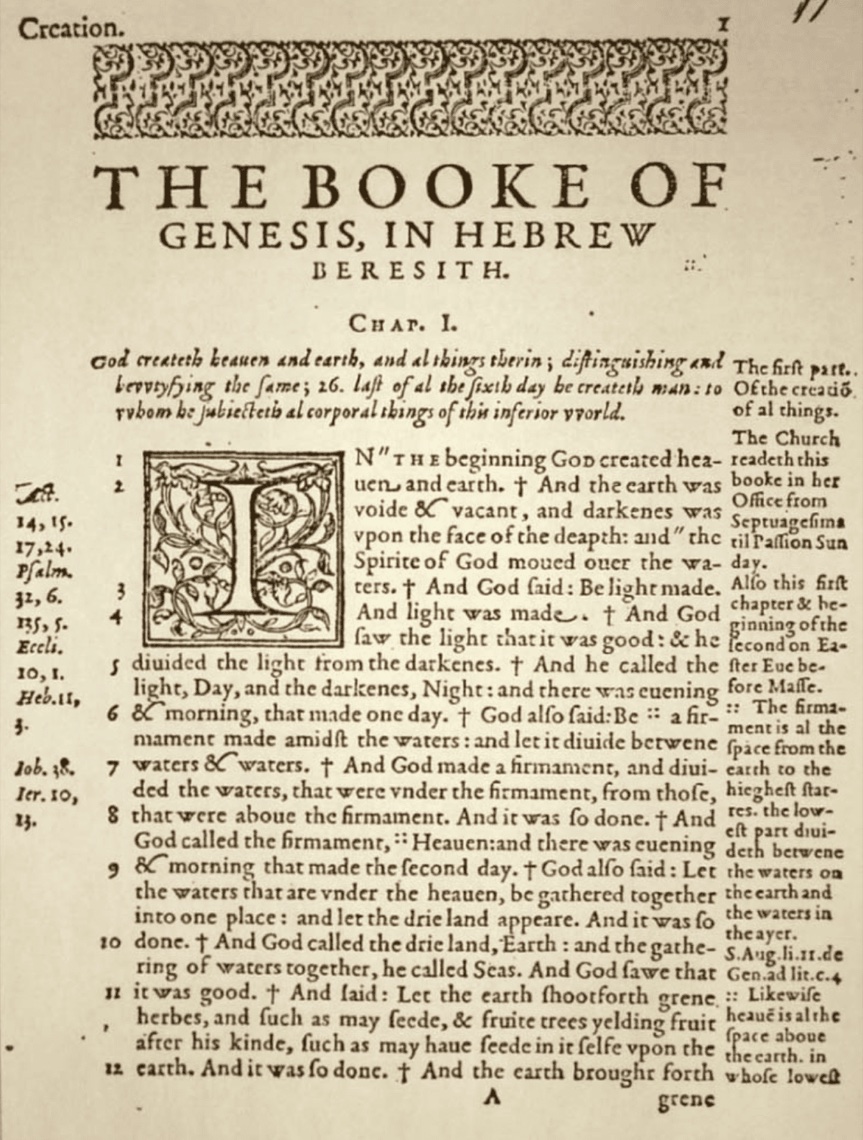
Genesis 1 from the 1609–1610 Douay Old Testament. Period spelling and typography throughout.
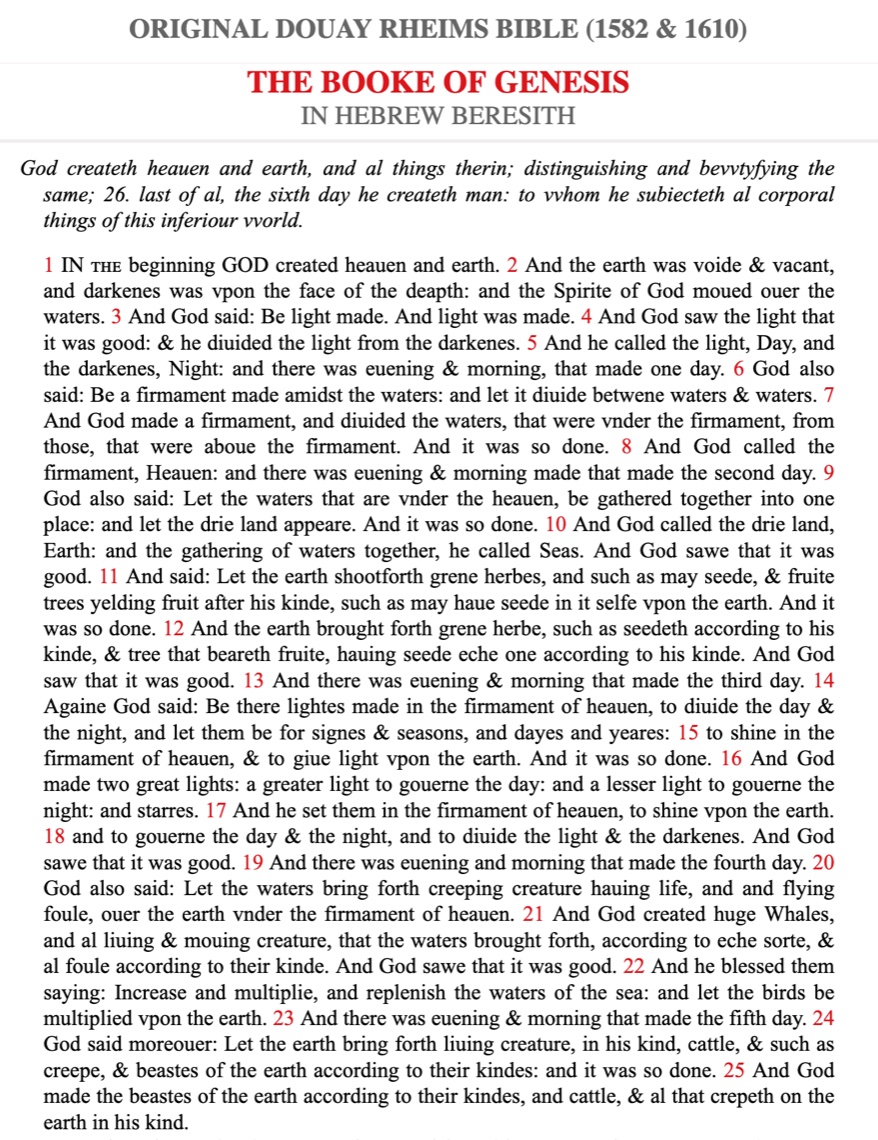
An earlier transcription project preserving the original spelling. No longer actively updated.
Two modern typeset editions also exist. Dr. William G. von Peters produced a meticulous modernised edition at realdouayrheims.com, but it is copyrighted. Patrick Madueke assembled a complete PDF transcription of the Original Douay-Rheims and placed it in his repository dedicated to Our Lady of La Salette, without copyright restriction. That repository is what this site is built on. Without his work, it could not have been built.
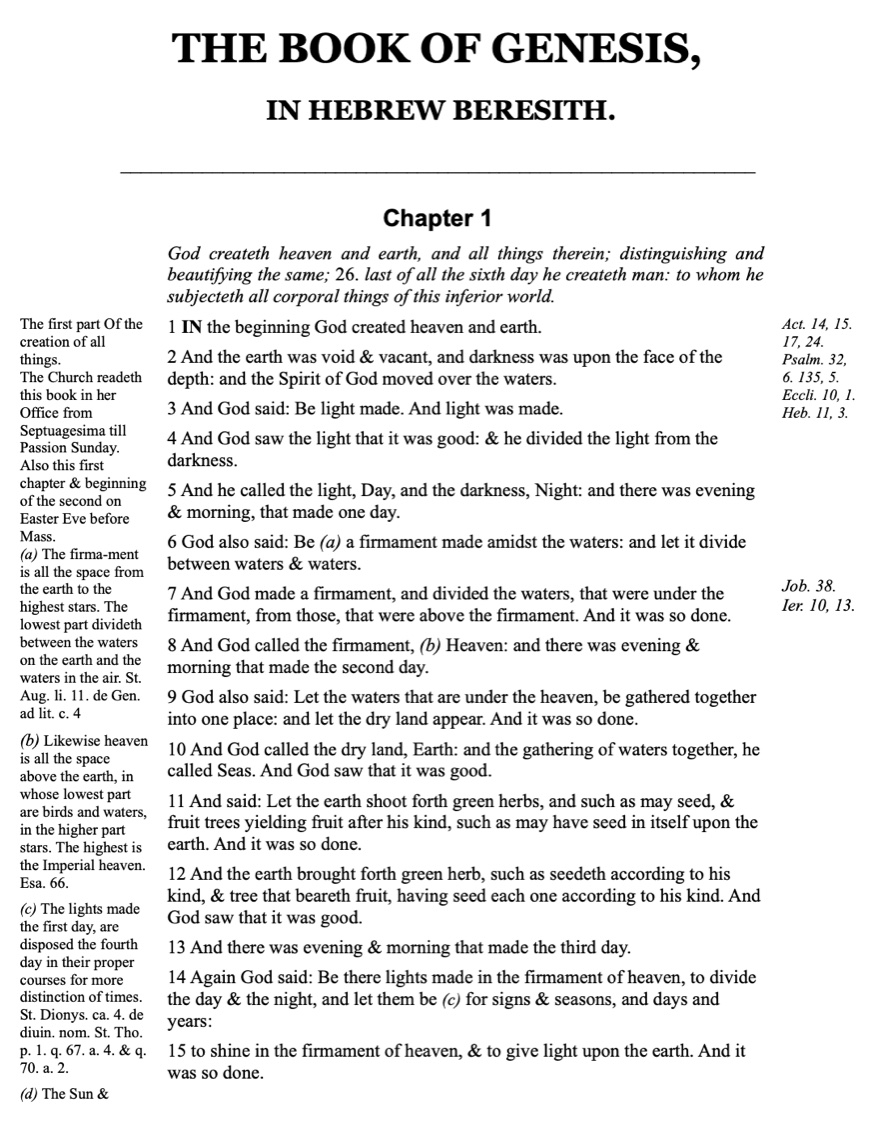
Dr. William G. von Peters's meticulous modern typeset edition. Copyrighted.
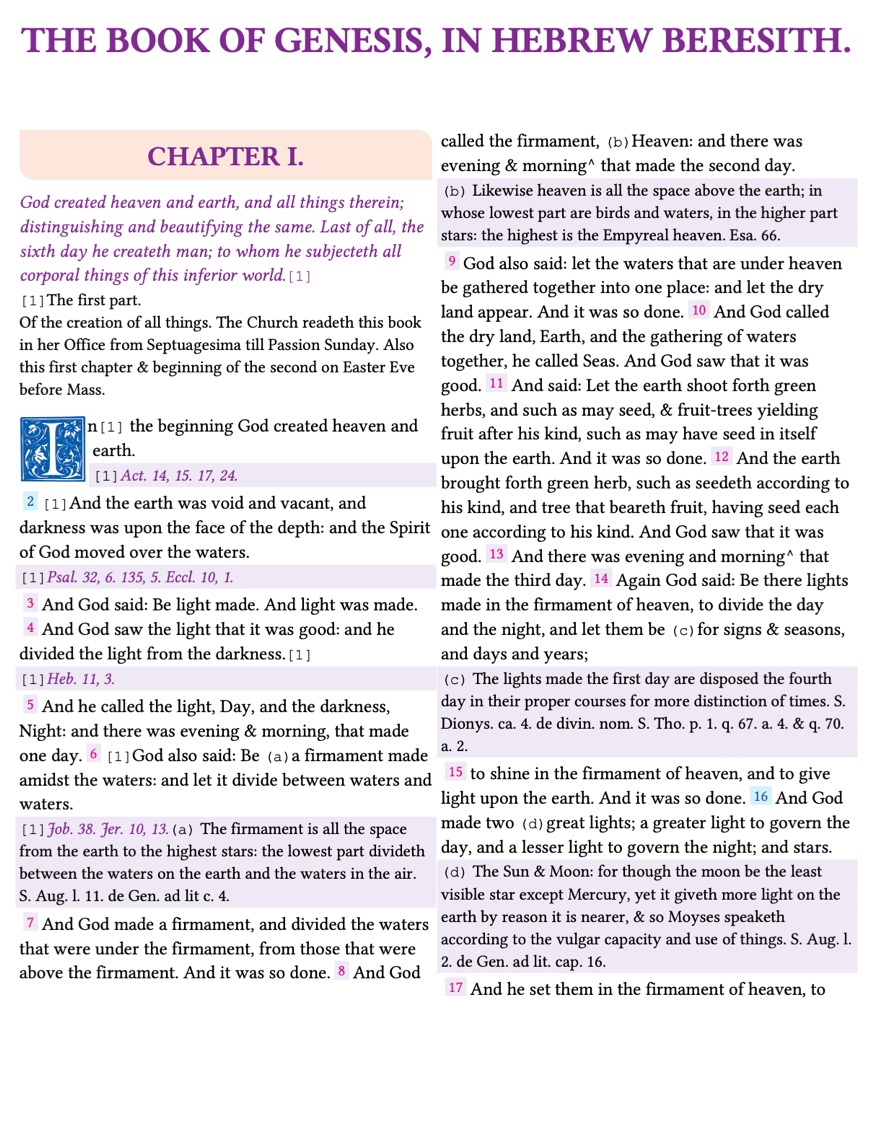
The open-source source text this site is built on.
This site was built to fill that gap: a freely accessible, fully searchable edition of Gregory Martin's original text, with the annotations, prefaces, and reference material that the translators included.
The texts, annotations, and references are free to read. No account required.
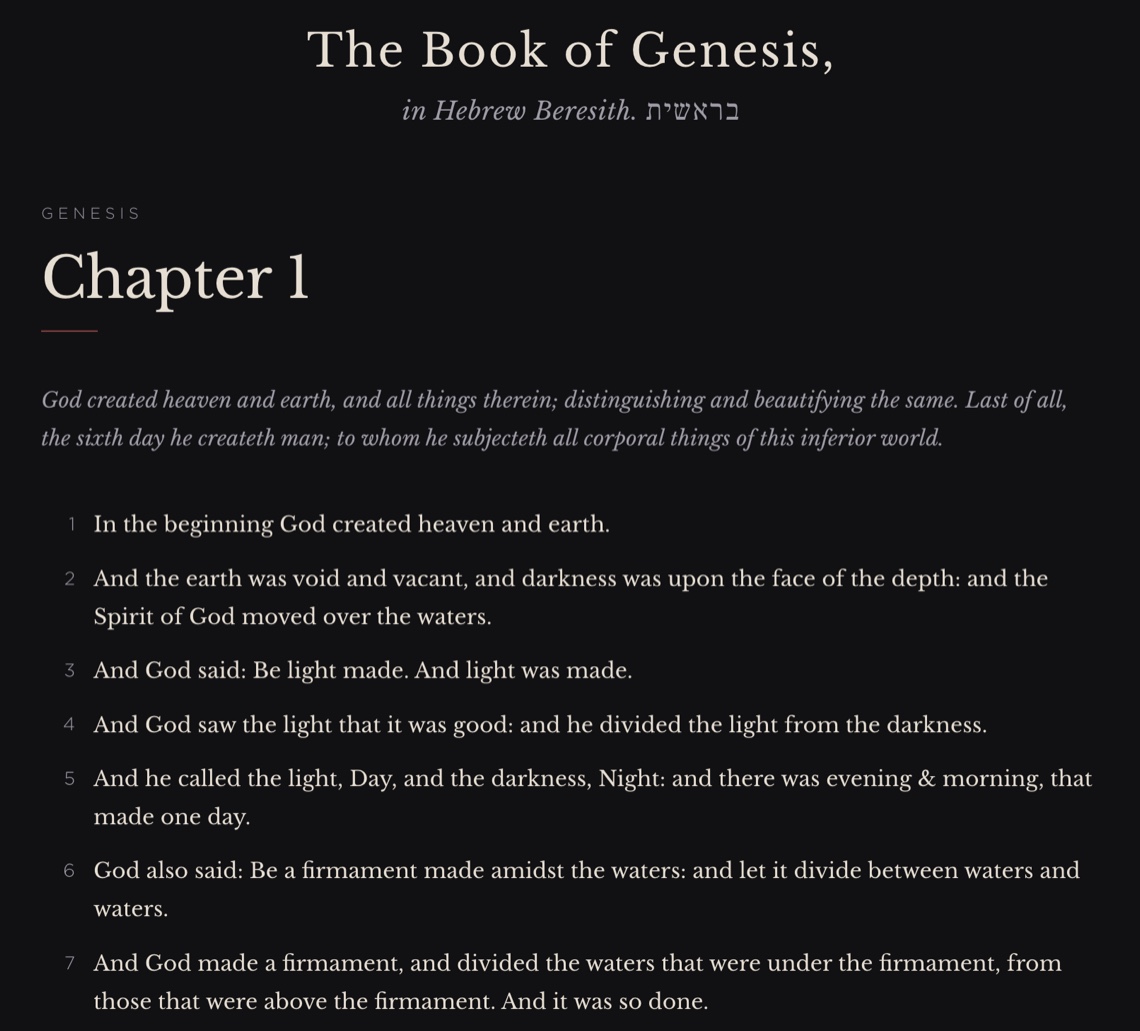
The text of Gregory Martin's original translation, freely readable and searchable for the first time.
Public Domain · CC0 1.0
The text, annotations, prefaces, and reference material on this site are in the public domain. You are free to copy, share, adapt, and redistribute them for any purpose, with no restrictions and no attribution required. The translations available on this site, along with Patrick Madueke's original PDF transcription, can be downloaded in JSON format from the download page and from the GitHub repository. A REST API is also available, with endpoints for individual verses, chapters, full books, random verses, and full-text search.
CC0 1.0 Universal →Genesis 1:1–2 across traditions
The opening verses of Genesis illustrate what separates the Original Douay-Rheims from its
successors. The Hebrew tōhû wābōhû is a rhyming pair unique to the language: two words bound together by
sound, evoking primordial chaos and emptiness.
The Latin Vulgate renders it inanis et vacua. The Original Douay-Rheims preserves that pairing as vacant and void, a v-alliteration that echoes the Hebrew rhythm.
Challoner replaced it with void and empty, losing the echo. The KJV reads without form, and void, departing further still.
1 In the beginning God created heaven, and earth. 2 And the earth was vacant and void: and darkness was upon the face of the deep; and the spirit of God moved over the waters.
1 In the beginning God created heaven, and earth. 2 And the earth was void and empty, and darkness was upon the face of the deep; and the spirit of God moved over the waters.
1 In the beginning God created the heaven and the earth. 2 And the earth was without form, and void; and darkness was upon the face of the deep. And the Spirit of God moved upon the face of the waters.
1 In principio creavit Deus cælum et terram. 2 Terra autem erat inanis et vacua, et tenebræ super faciem abyssi; et spiritus Dei ferebatur super aquas.
1 In the beginning God created the heaven and the earth. 2 But the earth was formless and vacant; and darkness over the face of the deep; and the spirit of God was borne upon the waters.
1 בְּרֵאשִׁית בָּרָא אֱלֹהִים אֵת הַשָּׁמַיִם וְאֵת הָאָרֶץ. 2 וְהָאָרֶץ הָיְתָה תֹהוּ וָבֹהוּ וְחֹשֶׁךְ עַל-פְּנֵי תְהוֹם; וְרוּחַ אֱלֹהִים מְרַחֶפֶת עַל-פְּנֵי הַמָּיִם.
1 Bərēʾšît bārāʾ ʾĔlōhîm ʾēṯ haššāmayim wəʾēṯ hāʾāreṣ. 2 Wəhāʾāreṣ hāyəṯāh ṯōhû wābōhû; wəḥōšeḵ ʿal-pənê ṯəhôm; wərûaḥ ʾĔlōhîm məraḥepeṯ ʿal-pənê hammāyim.
1 In beginning created God the heavens and the earth. 2 And the earth was waste and void; and darkness over face of deep; and spirit of God hovering over face of the waters.
Notes on This Edition
The text you read here has been modernised in spelling only. The vocabulary, grammar, and sentence structure of Gregory Martin's translation are unchanged. Nothing has been added, removed, or softened. Where the original says what it says, this site says the same.
Several caveats are worth stating plainly.
The source PDFs assembled by Patrick Madueke are themselves transcriptions and may contain transcription errors. Where the PDF text diverges from the printed facsimile, the facsimile takes precedence; but not every discrepancy has been identified or corrected.
The study notes, annotations, and marginal references were parsed programmatically from structured source files. Parsing errors may have introduced formatting mistakes, truncated notes, or misassigned references. If a note appears incomplete or malformed, this is almost certainly a parsing artefact rather than the original text.
No attempt has been made to reconcile the Original Douay-Rheims' notes with modern biblical scholarship. The translators wrote in 1582-1610 with the theological and textual knowledge of their time. Where the notes make historical claims, attribute authorship, or engage with the meaning of a passage in ways that modern scholarship would nuance or contest, the text is left as it stands.
This applies in full force to the annotations concerning Protestant translations. The translators wrote as polemicists in a confessional conflict. Their notes are pointed, sometimes severe, and written by men who regarded the Reformation as an assault on the faith. No effort has been made to soften them. They are part of the text.
Errors and Typos
The purpose of this site is preservation and presentation, not correction. It is not a critical edition, and it does not attempt to establish a definitive text. Where a clear error in the source material is confirmed, the correction is made and indicated in the study panel by an editorial note.
The only class of silent correction applied across the board is spelling modernisation: period spellings have been brought in line with contemporary orthography to aid readability, while leaving vocabulary, grammar, and sentence structure entirely untouched. Beyond this, the text is presented as faithfully as possible to the currently available source material.
Where a clear error in the source material has been identified (a word omitted, a name misspelt, a verse absorbed into a neighbouring verse), the correction is made and an editorial note is added in the study panel to document what was changed and why. These notes are visually distinguished from the original notes of the translators and commentators, and marked editorial. The intent is transparency: the reader can see what the source contains, what has been changed, and on what grounds.
If you encounter a problem in the text (a transcription error, a misformatted note, a truncated passage), please use the contact form to report it.
A Simple Idea
This project began as a chapter selector: a plain page with a dropdown to move between chapters. It was meant to take a weekend. It grew, as such things do, into something else entirely. The annotations required a study panel. The study panel required synchronised scrolling. The search required an understanding of the Original Douay-Rheims' own vocabulary and naming conventions. The comparison view required ingesting additional translations. Each feature followed naturally from the one before it.
The result is this site. It is offered freely, for anyone who wishes to read, study, or draw near to God through the first complete English translation of the Latin Vulgate, made without Protestant influence, from the text the Church has always held as its own.
St. Jerome, pray for us.
St. Edmund Campion, pray for us.
St. Carlo Acutis, pray for us.
Laus Deo.